
FOR TRADIES
Most tax content written for Australian tradies is either too generic to be useful or too technical to be readable. This guide is neither. It covers every meaningful tax and structure decision a tradie faces, with specific dollar examples in 2025-26 numbers, and it doesn’t assume you have a tax agent already on retainer.
Why tradies get tax wrong more than other small businesses
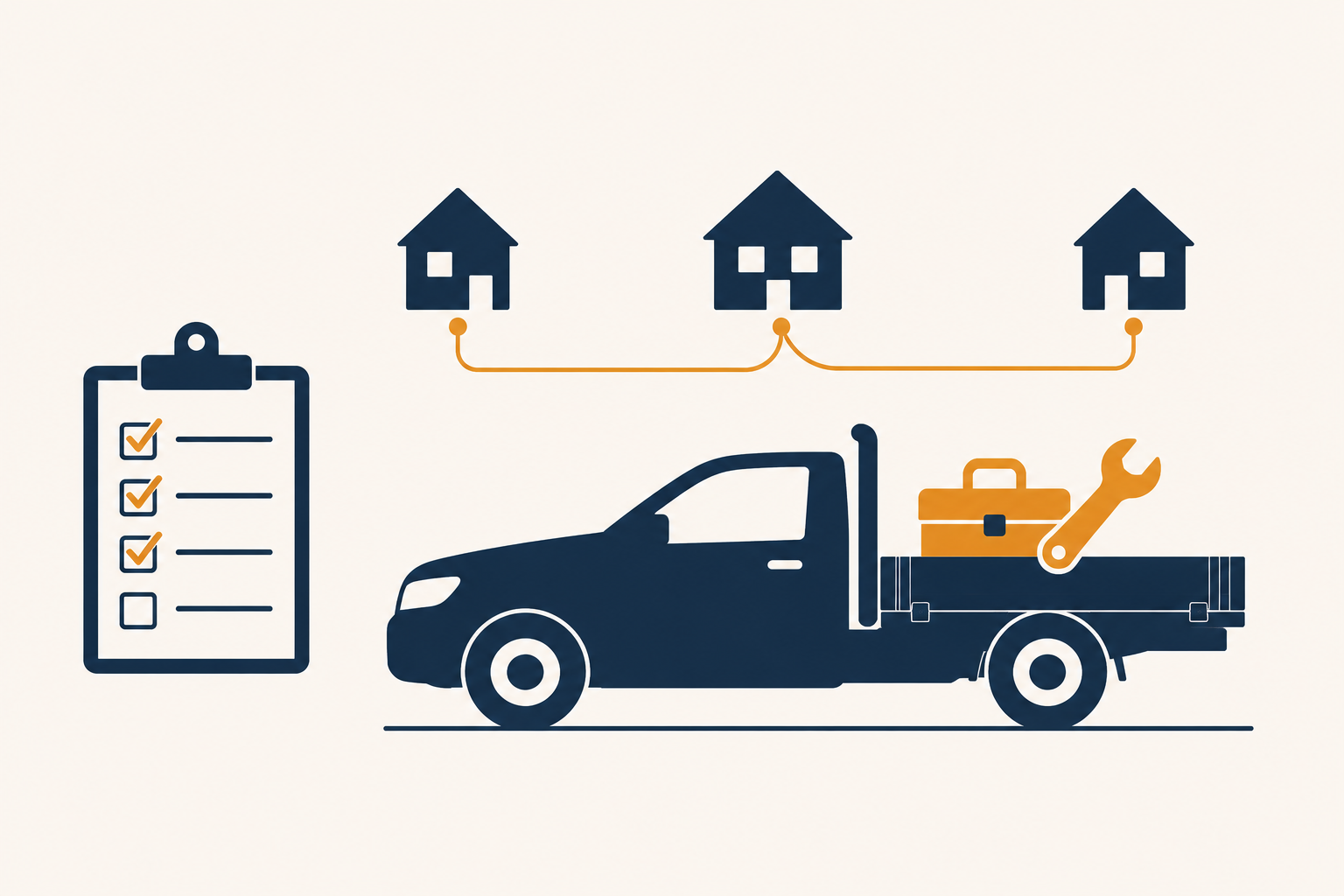
Tradies sit at an unusual intersection: highly variable income, high vehicle and tool costs, frequent shifts between contracting and being subcontracted, and physical work that often blurs the line between business and personal use. The result is that tradies are simultaneously eligible for more deductions than most small businesses and more likely to underclaim, overclaim, or miss obligations entirely.
The structure question: sole trader vs Pty Ltd
If you’re a tradie earning under about $130,000 per year, working mostly on your own with no significant inventory or contracts that put your assets at risk, sole trader is probably the right structure. Compliance cost is low ($800-$2,000/year), the tax treatment is identical to wages for most of your income range, and the simplicity matches the size of the business.
Consider moving to a Pty Ltd when you bring on employees, hold $30,000+ of tools or inventory, sign contracts that put real money at risk, your income consistently exceeds $135,000, or you’re tendering for work that requires “the contracting entity is a company”. For the full structure decision, read our business structures guide or try the calculator.
Vehicle deductions: the biggest, most-missed item
Vehicle costs are usually a tradie’s largest single deduction. Get this right and it’s worth $5,000-$15,000+ a year in legitimate tax savings.
Two methods, only two
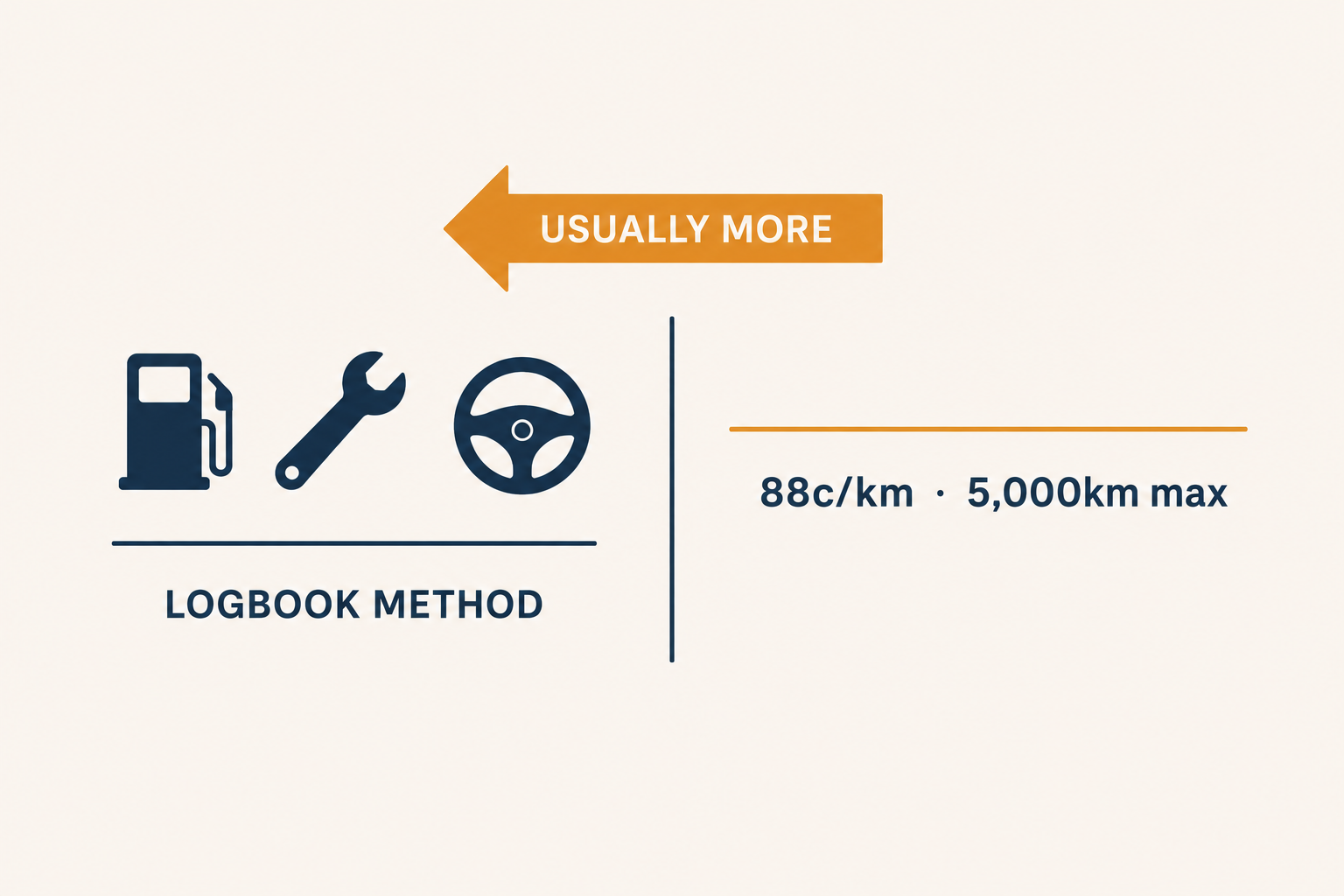
Cents-per-kilometre method: claim 88 cents per km (2025-26 rate) up to 5,000 work km/year. Max claim: $4,400. Best for low-mileage tradies.
Logbook method: track every work trip for a continuous 12 weeks to establish a business-use percentage, then apply that percentage to actual costs – fuel, registration, insurance, servicing, depreciation, interest if financed. The 12-week logbook is valid for 5 years.
For most tradies, the logbook method wins by a large margin. A typical sub-contractor putting 20,000 km on a ute with 80% business use can claim about $14,800 vs $4,400 cents-per-km.
$10,000+ extra deduction = $3,000+ saved at 30% marginal rate.
What counts as a “work trip”
Travel between home and a regular place of work is not deductible (that’s commuting). But for most tradies, there is no “regular place of work” – you go to different sites each day. In that case, travel from home to the first job, between jobs, and from the last job back home is all deductible. If you carry tools that wouldn’t reasonably travel on public transport, the home-to-first-job leg is also deductible regardless.
Tools and equipment
Every tool you buy for work is deductible. For 2025-26, the instant asset write-off threshold is $20,000 per asset (subject to ATO confirmation). Under that, claim the full cost in the year of purchase. Above it, depreciate over the asset’s effective life.
What’s deductible
- Power tools, hand tools, cordless tools and replacement batteries
- Safety gear (boots, hi-vis, hard hats, safety glasses, respirators)
- Tool storage (toolboxes, racks, ute bodies)
- Compressors, generators, scaffolding, ladders
- Tradie-specific software (job-management apps, quoting tools)
- Phone and internet (work-use percentage)
- Trade subscriptions, union dues, license renewals, ongoing training
Home office deduction
If you spend time at home on admin, quoting, ordering materials, or managing the business, you can claim. Two methods for 2025-26:
Fixed-rate method: 70 cents per hour worked from home, covering energy, internet, mobile, stationery, computer consumables, cleaning. Need a record of hours worked.
Actual cost method: claim a portion of actual home expenses based on the area used exclusively for business. More work, often larger deduction if you have a dedicated office.
For most tradies doing admin at the kitchen table 7 hours/week × 48 weeks: fixed-rate gives ~$235/year, for fixed-rate method. Modest, but real money.
GST for tradies
You must register for GST when business turnover hits $75,000 in any rolling 12-month period. Once registered, you add 10% GST to every invoice, claim back GST on business purchases, and report/remit quarterly via BAS. The trap: charging GST before registering. Until your ABN is GST-registered, you cannot legally charge GST.
Contractor vs employee: the test that catches everyone
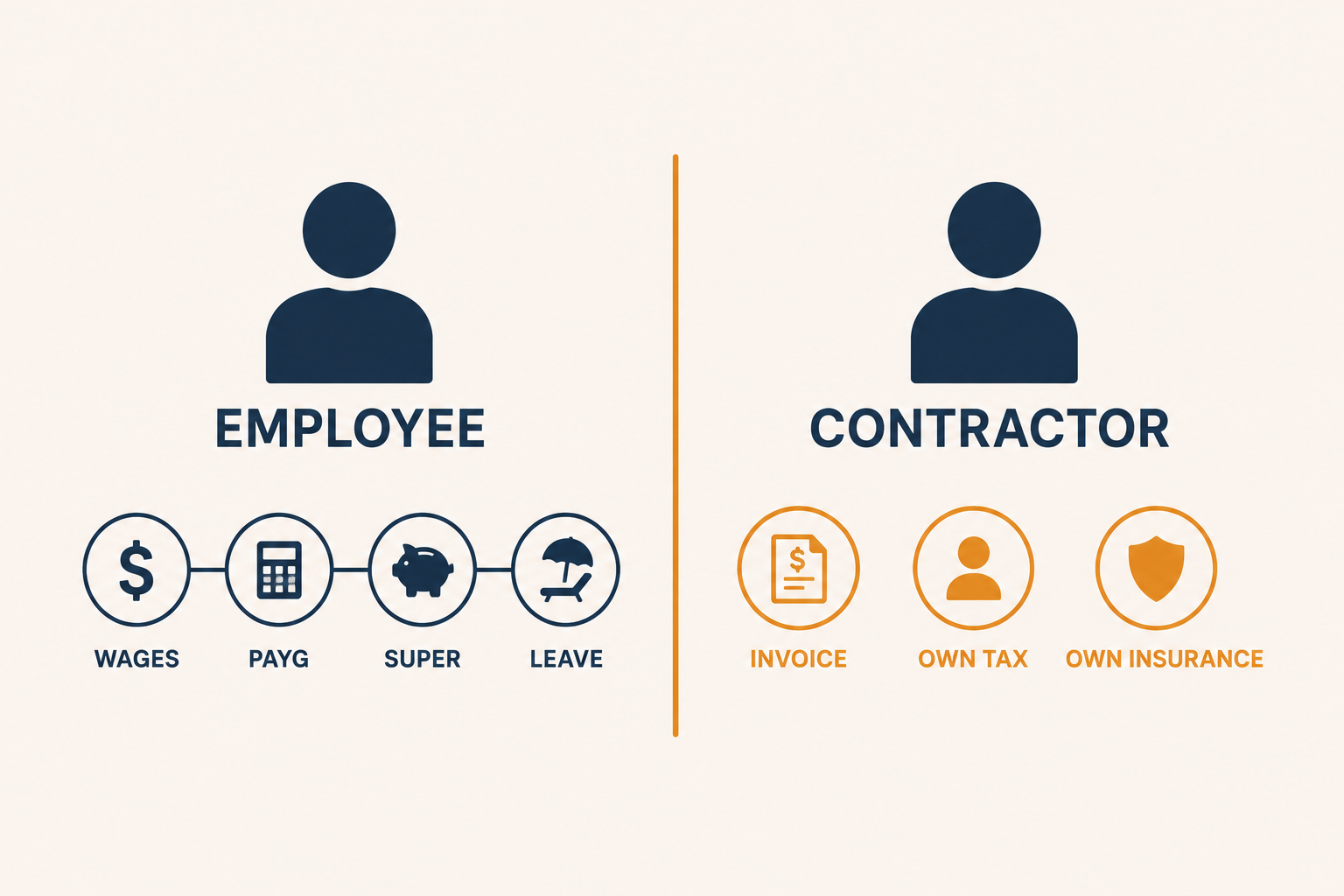
If you take on someone to help – even a mate, even casually – you and the ATO need to be on the same page about whether they’re a contractor (responsible for their own tax and super) or an employee (you withhold tax and pay super). Getting this wrong is one of the most expensive mistakes a small business can make.
The ATO’s test
The ATO weighs several factors: control (who decides when, where, how), right to delegate, who supplies tools, who bears commercial risk, payment basis (for result vs for time), integration into your business, multiple clients vs just you. Just having an ABN doesn’t make someone a contractor.
If you’re paying someone the equivalent of “wages by the hour”, setting their hours, providing tools, telling them when to be on site, and they work only for you – they’re an employee, almost certainly. If they have multiple clients, set their own hours, supply own tools, invoice a result not hours, and could send a substitute – they’re a contractor. Middle ground: get specific advice before paying anyone for the first time.
Insurance: the deductions tradies miss
Every business-related insurance premium is deductible: public liability, tools and equipment insurance, professional indemnity, income protection (for sole traders), commercial vehicle insurance, trade-specific cover.
EOFY checklist for tradies
- Pre-purchase consumables: safety gear, small tools, replacement bits
- Service the vehicle in June
- Bring forward larger purchases under instant asset write-off threshold
- Pay super for the June quarter by 28 July (earlier for safety)
- Update your logbook if you’ve switched vehicles or changed usage
- Review prepayments – some June expenses for next 12 months deductible now
- Don’t forget bad debts: write off uncollectable invoices before 30 June
Plain-English Australian tax in your inbox each week
For tradies, SMEs, and founders. Free, forever.
Frequently asked questions
Can I claim my work boots?
Yes. Steel-cap boots and other PPE worn at work are fully deductible.
What about my work clothes?
Compulsory uniforms and protective clothing with a logo are deductible. Generic shirts, jeans, even hi-vis without a logo are generally not deductible.
Can I claim the cost of my license?
Ongoing license renewal fees: yes. Initial training to qualify for a new trade: usually no.
Can I claim my phone bill?
Yes – the work-use percentage. Keep a 4-week diary at least once a year to substantiate.
Do I need a separate business bank account?
Legally no (if sole trader). Practically yes – makes everything easier at tax time and during ATO audits.
Sources
- ATO – Vehicle and travel expenses: ato.gov.au/individuals/income-deductions-offsets-and-records/deductions-you-can-claim/transport-and-travel-expenses
- ATO – Working from home expenses: ato.gov.au/individuals/income-deductions-offsets-and-records/deductions-you-can-claim/working-from-home-expenses
- ATO – Employee or contractor: ato.gov.au/businesses-and-organisations/preparing-lodging-and-paying/employee-or-contractor
- ATO – Instant asset write-off: ato.gov.au/businesses-and-organisations/income-deductions-and-concessions
Disclaimer: General educational information for Australian tradies based on tax law as at May 2026. Vehicle and home-office substantiation rules have specific requirements; consult a registered tax agent before claiming.