FOR FOUNDERS · FOR NEW BUSINESS OWNERS
Choosing your business structure is one of the most consequential decisions you’ll make as an Australian founder. Get it wrong, and you’ll pay more tax than you need to, expose your personal assets to liability you don’t deserve, or trip over compliance obligations nobody warned you about. Get it right, and the structure quietly compounds in your favour for decades.
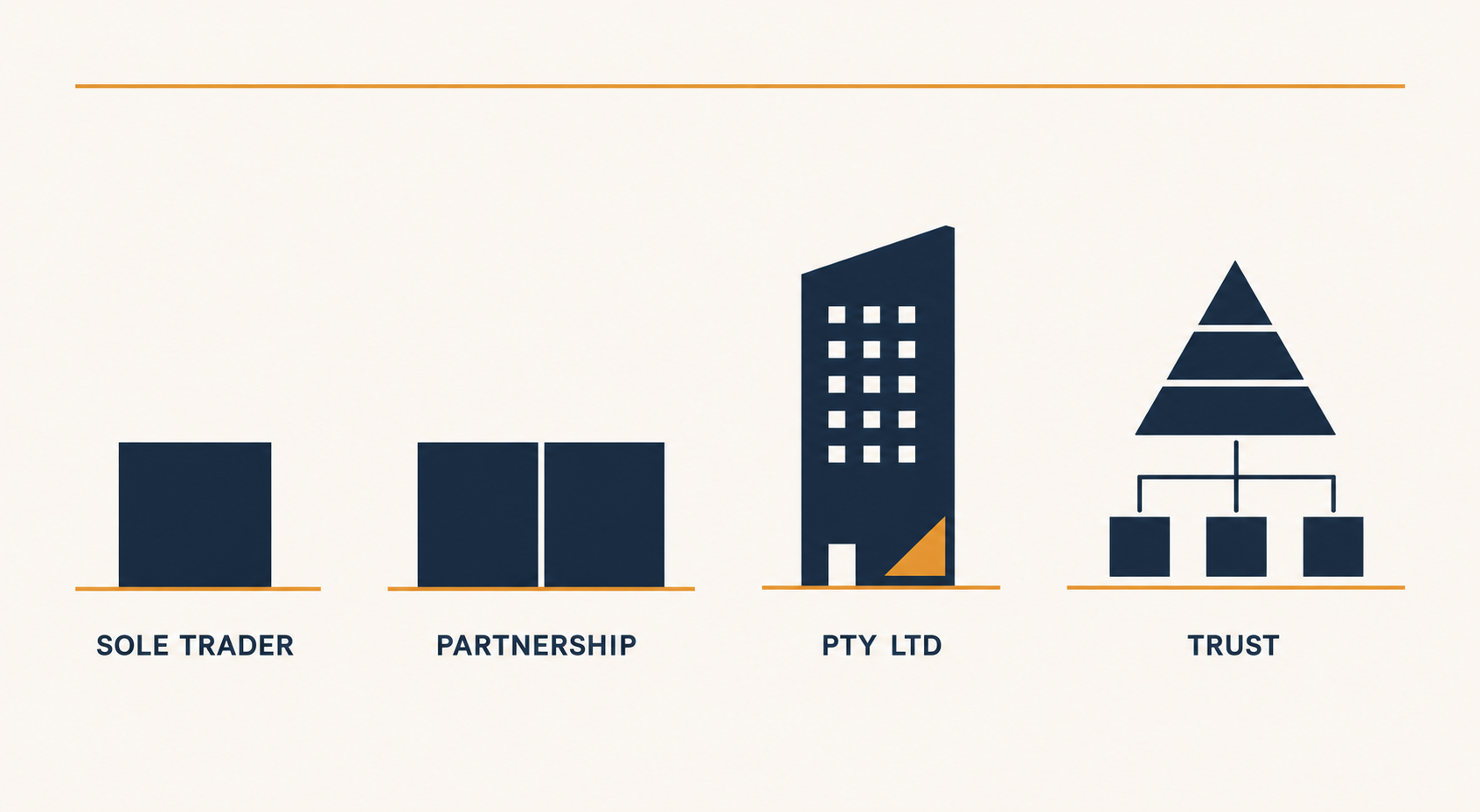
This guide explains the four main Australian business structures in plain English, with worked examples in 2025-26 dollars. It is the homework you should do before booking time with a registered tax agent – not a substitute for that conversation.
The numbers, before the rules
An Australian sole trader earning $120,000 in 2025-26 pays approximately $26,800 in personal income tax plus $2,400 in Medicare levy. The same $120,000 earned inside a Base Rate Entity Pty Ltd attracts $30,000 in company tax. Almost identical at the headline level. But the moment you draw the company’s after-tax money out as a wage, the personal-rate maths kicks in again, and the apparent saving disappears.
The conclusion most founders miss: for incomes under roughly $135,000, the headline tax rate is rarely the deciding factor between structures. What matters is what you’re trying to protect, who else you want to share the business with, and what you want to happen as the business scales.
The rest of this article walks through that – structure by structure, with the trade-offs spelled out.
What a “business structure” actually is
A business structure is the legal entity that owns the business and earns the income. It determines who pays the tax, who owes the debts, who can sue you, and what paperwork the ATO and ASIC expect from you each year.
Australia recognises four main structures. There are variants of each – companies limited by guarantee, hybrid trusts, special purpose entities – but in practice, almost every Australian small business operates under one of these:
- Sole trader – you are the business. Simplest, cheapest, riskiest.
- Partnership – two or more people share the business. Same operational simplicity as sole trader, but liability and conflicts get complicated when other humans are involved.
- Pty Ltd company – a separate legal entity owns the business. More expensive to run, more paperwork, but your personal assets stop being on the line for business debts.
- Trust – a legal structure where a trustee holds business assets for beneficiaries. Powerful for income flexibility and asset protection, but complex enough that most accountants charge extra to set one up.
You can also run hybrid structures, the most common being a Pty Ltd company that acts as the trustee of a discretionary family trust. We’ll cover hybrids at the end.
Sole trader: the default starting point
If you start earning money through your own work and you haven’t formally set up anything else, you are a sole trader by default. This is how the overwhelming majority of Australian businesses begin.
What a sole trader is
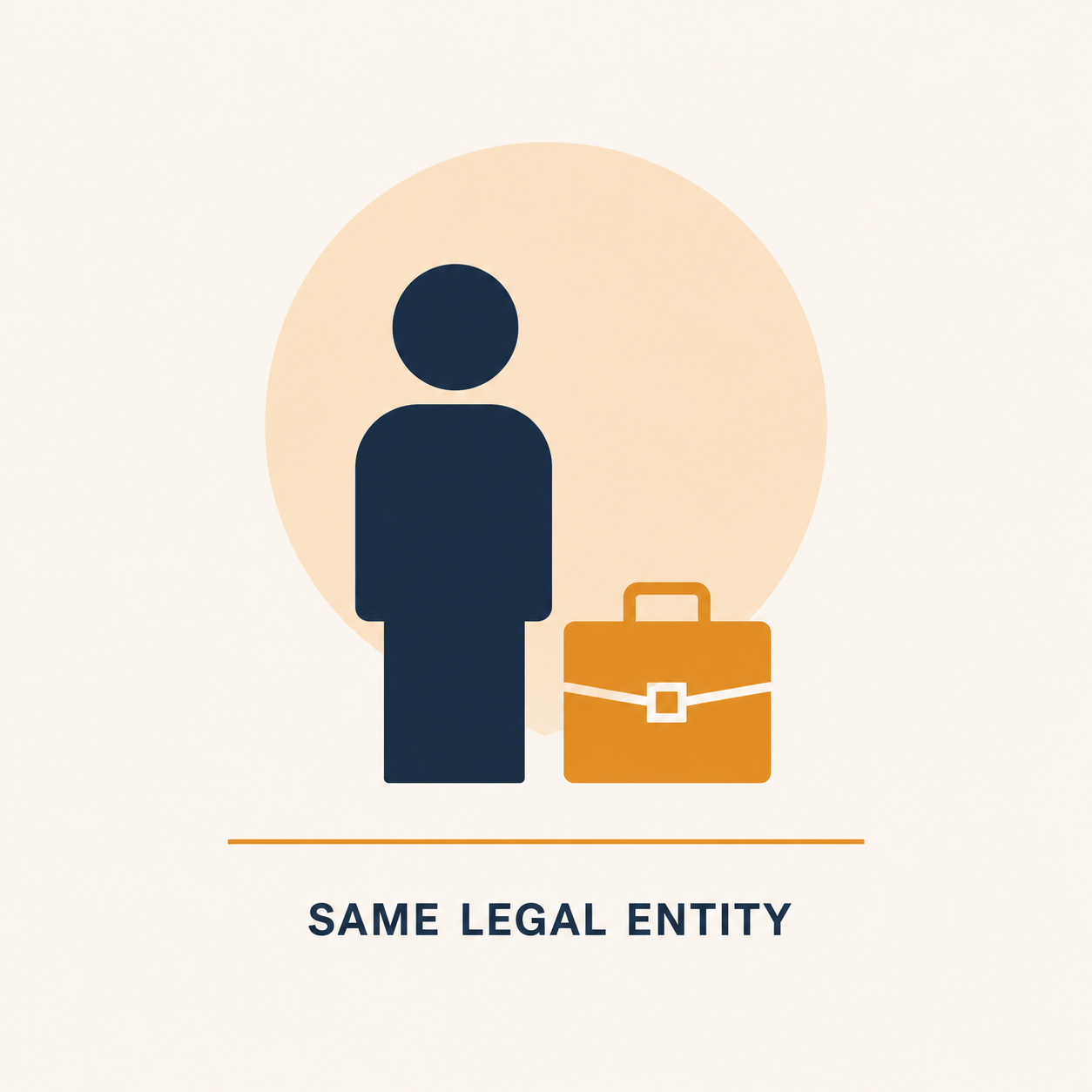
You operate the business in your own name, using your individual Tax File Number, with an Australian Business Number registered for tax purposes. The business income is your income. The business expenses are your deductions. There is no legal distinction between you and the business – they are the same legal entity in the eyes of the ATO and the courts.
How it’s taxed
You include the business’s net profit in your personal tax return on the supplementary Section B page. It gets added to any salary or other income you earn, and you pay tax at the personal income tax rates for 2025-26:
- $0 – $18,200: 0% (the tax-free threshold)
- $18,201 – $45,000: 16%
- $45,001 – $135,000: 30%
- $135,001 – $190,000: 37%
- $190,001 and above: 45%
You also pay the Medicare levy of 2% on most of your taxable income above the threshold ($27,222 in 2025-26 with phase-in to $34,027), and possibly the Medicare levy surcharge if you earn over $101,000 and don’t have private hospital cover.
If your business turnover is more than $75,000, you must register for GST. If you employ anyone, you must register for PAYG withholding and pay superannuation guarantee at the current rate (12% from 1 July 2025).
How liability works
This is where the simplicity becomes the trap. Because you and the business are the same legal entity, every business debt is your debt personally. If a customer sues your business and wins, they can come after your house, your car, your savings, and your future income. There is no firewall.
For low-risk businesses – a freelance copywriter, a sole-trading bookkeeper, a sole tradie with public liability insurance – this exposure is often manageable. For higher-risk businesses with employees, equipment that can hurt people, large customer contracts, or significant inventory, the lack of a liability firewall is a serious problem.
Worked example: Sarah, a freelance graphic designer
Sarah earns $85,000 in net business income in 2025-26. She has no employees, works from home, and her clients are mostly other small businesses on monthly retainers.
Her tax bill as a sole trader:
- Personal income tax on $85,000: approximately $16,300
- Medicare levy: $1,700
- Total: approximately $18,000
- After-tax income: $67,000
Her compliance: an annual tax return, quarterly BAS if she’s GST-registered, and quarterly PAYG instalments once the ATO has assessed her. Total accountant fees in 2025-26 would typically be $800 to $2,000.
Compare this to setting up a Pty Ltd: she’d pay $611to ASIC for the company registration, $329/year ASIC annual review fees, $2,000 to $3,500 in ongoing compliance fees, and gain marginal liability protection that her professional indemnity insurance largely already provides. For Sarah, sole trader is the right call.
Best for
Sole trader works well when:
- The business risk is low (services, not products that can hurt people)
- Income is below roughly $135,000 per year
- You’re the only person involved
- You’re testing whether the business will work before investing in structure
- You can buy adequate insurance to cover plausible risks
It stops working when income grows substantially, when you bring on partners or employees, when you take on contracts that put real assets at risk, or when you want to retain earnings inside the business rather than draw them all into your personal income each year.
Partnership: simple in theory, fragile in practice
A partnership is two or more people running a business together without forming a company. It is, structurally, two or more sole traders sharing the income, the expenses, and the headaches.
Two main types
In Australia you can set up a general partnership, where every partner is jointly and severally liable for the partnership’s debts (meaning each partner is personally on the hook for everything, not just their share). Or you can set up a limited partnership, where some partners can limit their liability to their initial investment, but at least one partner must be a general partner with unlimited liability. Limited partnerships are uncommon for typical Australian small businesses.
How it’s taxed
The partnership itself doesn’t pay income tax. It lodges a partnership return that calculates the net partnership income. That income is then split between the partners according to their partnership agreement, and each partner reports their share on their personal tax return.
This is sometimes called “flow-through” taxation: the partnership is transparent for tax purposes. The partnership pays no tax; the partners do.
How liability works
The big risk: in a general partnership, you are liable not just for debts you personally cause, but for debts your partner causes too. If your business partner runs up a $200,000 debt without your knowledge, the creditor can come after your personal assets for the full amount. Your only recourse is to chase your partner for their share – a recourse that often arrives years too late.
This is why partnerships have a reputation for ending badly. Most do, eventually – through buyouts, breakdowns, or one partner exiting. The structure has no built-in mechanism for handling change.
When it makes sense
Partnerships work for small, low-risk operations between people with deep, tested trust – typically family members or long-time business partners – where the simplicity of sole trader-style taxation is more valuable than the liability protection of a company.
For most other situations, founders who think they want a partnership probably want a Pty Ltd company with clearly-documented shareholdings instead. The legal complexity of a Pty Ltd is broadly similar to a properly-drawn partnership agreement, but the liability protection is meaningfully better.
Want a quick numbers check on your specific income?
Try the Sole Trader vs Pty Ltd Calculator – 30 seconds, side-by-side tax outcomes for any income level.
Pty Ltd company: the workhorse for serious small business
A proprietary limited (Pty Ltd) company is a separate legal entity from its owners. It can own assets, sign contracts, sue, be sued, and earn income in its own right. The shareholders own the company; the company owns the business.
This separation is the single most important feature of a Pty Ltd, and the reason most growth-oriented Australian businesses use one.
How it’s taxed
A Pty Ltd company pays company tax on its taxable profits. The 2025-26 rates:
- Base Rate Entity (BRE): 25% – applies if aggregated turnover is under $50 million and no more than 80% of assessable income is “base rate entity passive income” (interest, dividends, rent, royalties, net capital gains)
- Standard company rate: 30% – applies to companies that don’t qualify as BREs
The vast majority of operating Australian SMEs qualify as BREs because they earn most of their income from active trading (selling products, performing services), not passive investment.
When the company pays profits out to its shareholders as dividends, those dividends carry “franking credits” that prevent the same income being taxed twice. If the company has paid 25% tax on a profit and then distributes it as a fully-franked dividend, the shareholder receives a tax credit equal to the company tax paid. The shareholder pays personal tax on the full pre-tax profit but offsets it with the franking credit. The economic effect: profits drawn out by the shareholder end up taxed at the shareholder’s personal rate, with the company tax acting as a kind of pre-payment.
This is why the apparent “tax saving” from operating through a Pty Ltd often disappears once you actually take the money out. The structural advantage isn’t the headline rate – it’s the ability to retain profits inside the company and defer the personal-rate tax until you draw the money.
How liability works
The shareholders’ personal liability is generally limited to the amount they paid for their shares. If the company goes bust owing money, the creditors can take whatever the company owns, but they generally cannot come after the shareholders’ personal assets.
There are exceptions. Directors can be personally liable in cases of insolvent trading (continuing to trade when the company can’t pay its debts), unpaid PAYG withholding and super (where ATO directors’ penalty notices apply), and some specific breaches of director’s duties. But the overall protection is meaningful and is the main reason businesses with employees, inventory, or significant contracts choose to operate as a company.
Compliance and cost
A Pty Ltd has more obligations than a sole trader:
- ASIC registration ($611 to set up at time of writing) and an annual review fee (currently $329 for a small proprietary company)
- A registered office address and at least one director who ordinarily resides in Australia
- Annual financial statements, even if you’re a small proprietary company exempt from formal audit
- A separate bank account (legally required – the company is a separate person)
- Annual company tax return separate from your personal return
- Director’s duties under the Corporations Act 2001 – keeping the company solvent, acting in good faith, avoiding conflicts of interest
Typical annual accounting fees for an active small Pty Ltd run $2,500 to $5,000, depending on transaction volume and complexity.
Worked example: James, an e-commerce founder
James runs a Shopify store selling outdoor gear. The business does $400,000 in revenue in 2025-26 and nets $150,000 after costs. He holds inventory worth around $80,000 at any time and ships 30 orders per day from a small warehouse.
If James operated as a sole trader, that $150,000 of profit would attract personal income tax of approximately $36,840 plus Medicare levy of $3,000- total around $39,840. If James operated as a Pty Ltd (BRE rate 25%), the company would pay $37,500 in company tax. Apparent saving: $2,340. Negligible.
The real reason James chose Pty Ltd: his $80,000 of inventory and the contracts with his suppliers and 3PL warehouse are all held by the company, not by him personally. If a defective product injures a customer, or his warehouse partner sues for a billing dispute, his house and savings are not exposed. That liability protection – for an active business holding stock and signing contracts – is worth far more than the negligible tax difference.
Best for
Pty Ltd is the right call when your business carries meaningful liability (employees, inventory, customer-facing risk, big contracts), when you want to retain profits inside the business to fund growth rather than draw everything as personal income, when you expect to bring on co-founders, investors, or eventual sale of equity, or when your income level is high enough that the company tax rate (25%) is meaningfully lower than your personal marginal rate and you genuinely retain profits.
It is overkill when income is low, the business is purely services with no material liability, and you’d be drawing all the profit anyway.
Trust: powerful, complex, often misunderstood
A trust is not strictly a separate legal entity in the same way a company is. It’s a legal arrangement where a trustee holds assets and earns income on behalf of beneficiaries. The trust itself doesn’t own anything – the trustee does, in their capacity as trustee.
There are several types of trusts used in business. The two most common in Australian small business:
- Discretionary trust (often called a “family trust”) – the trustee has discretion to distribute income and capital among a defined class of beneficiaries (typically family members) each year. Used widely for small business and investment income.
- Unit trust – beneficiaries hold fixed “units” similar to shares in a company. Used when there are unrelated parties with defined entitlements, or for specific commercial structures.
We’ll focus on discretionary trusts because they’re the most common in operating-business contexts.
How a discretionary trust is taxed
Every year, the trustee decides how to distribute the trust’s income among the beneficiaries (within the defined class – typically family members). Each beneficiary then pays tax on their share at their personal rate.
This is the key feature: income flexibility. If you have a year where one family member earns $200,000 from a job and another earns nothing, the trustee can distribute trust income to the lower-earning family member to spread the tax burden. If everyone in the family is on a high marginal rate, the trustee can distribute to a Pty Ltd “bucket company” that pays the BRE 25% rate, retaining the cash inside the company until needed.
Crucially: any trust income that isn’t distributed at year-end is taxed at the top marginal rate (45% plus Medicare levy = 47%) in the hands of the trustee. Trustees almost always distribute fully each year to avoid this.
How liability works
Because the trust isn’t a separate legal entity, the trustee is personally liable for trust debts – unless the trustee is itself a company. This is why most operating discretionary trusts use a Pty Ltd company as the trustee. The Pty Ltd’s limited liability shields the human directors from trust debts in most cases.
The standard structure is therefore: a Pty Ltd company (call it “Trustee Pty Ltd”) acts as trustee for a family trust. The trust runs the operating business. The directors of Trustee Pty Ltd are the family principals. This is the “company-as-trustee-of-a-trust” structure many Australian small businesses use.
Compliance and cost
Trusts come with the highest setup and ongoing complexity of the four structures: trust deed (typical setup cost AUD 1,500 to 3,500), stamp duty in some states, a Pty Ltd company to act as trustee adds another set of ASIC fees, annual trust tax return separate from individual returns, and an annual trustee resolution documenting income distribution decisions before 30 June each year (failure to do this means the trust income is taxed at the top marginal rate by default).
Typical annual accounting fees for a discretionary trust running an operating business: AUD 4,000 to 8,000.
Worked example: the Liu family
Mark Liu owns a chain of three café-style food businesses in Melbourne. The combined operations net $280,000 a year. His wife Wei works in the businesses but isn’t paid a market wage. Their two adult children, both at university, have minimal income.
If Mark held the business as a sole trader, he’d pay roughly $100,000+ in tax (personal income tax + Medicare levy + possible Medicare Levy Surcharge).
In a discretionary trust with Pty Ltd trustee, the trustee can distribute $90,000 to Mark, $90,000 to Wei, $30,000 each to the two adult children (under their tax-free threshold + low-bracket rates), and $40,000 retained in a “bucket” Pty Ltd at 25%. Approximate combined tax across the family: roughly $50,000 – a meaningful saving compared to the sole-trader scenario.
That income-splitting flexibility is the headline reason families with active businesses use discretionary trusts. The catch: the structure is more complex, more expensive to maintain, and subject to anti-avoidance rules (Part IVA, Section 100A, and the general anti-avoidance provisions). The ATO scrutinises distributions more closely than it used to, particularly distributions to adult children that the ATO considers to lack genuine economic purpose.
Best for
Trusts work well when multiple family members can legitimately share in the business income, when you’re holding assets long-term (especially appreciating assets – trusts can access the 50% CGT discount that companies can’t), when you want strong asset protection from creditors of individual beneficiaries, when the income level is high enough to justify the complexity and ongoing cost (typically $200,000+ in distributable income), and when you’re willing to invest in proper professional advice.
They’re overkill for solo operators with no family members to distribute to, for low-income businesses where the saving doesn’t justify the cost, and for any situation where you don’t have a tax agent who actively manages the structure each year.
Hybrid structures: the company-as-trustee combination
The most common Australian small-business structure for slightly-larger operating businesses is the hybrid: a Pty Ltd company that acts as the trustee of a family trust that runs the business.
Why combine them? The trust gives you income-splitting flexibility across family beneficiaries. The Pty Ltd trustee gives you limited liability for the directors. The structure is recognised, well-understood, and easy for accountants to manage.
It’s expensive to set up – you’re running two entities, each with their own compliance – but for businesses earning $200,000+ in profit with multiple family members on different income levels, the tax savings often justify the complexity.
A second common hybrid: a Pty Ltd operating company plus a separate “bucket” Pty Ltd holding accumulated profits. The operating company pays dividends to the bucket company at the franking-credit-friendly company rate, where the cash sits until needed for investment or future distribution. Used when the family doesn’t want to draw all profits each year and is willing to defer personal-rate tax in exchange for the structure.
These are second-order setups. They don’t make sense until your income, complexity, or asset base justifies the cost. Get the basic structure right first.
A decision framework
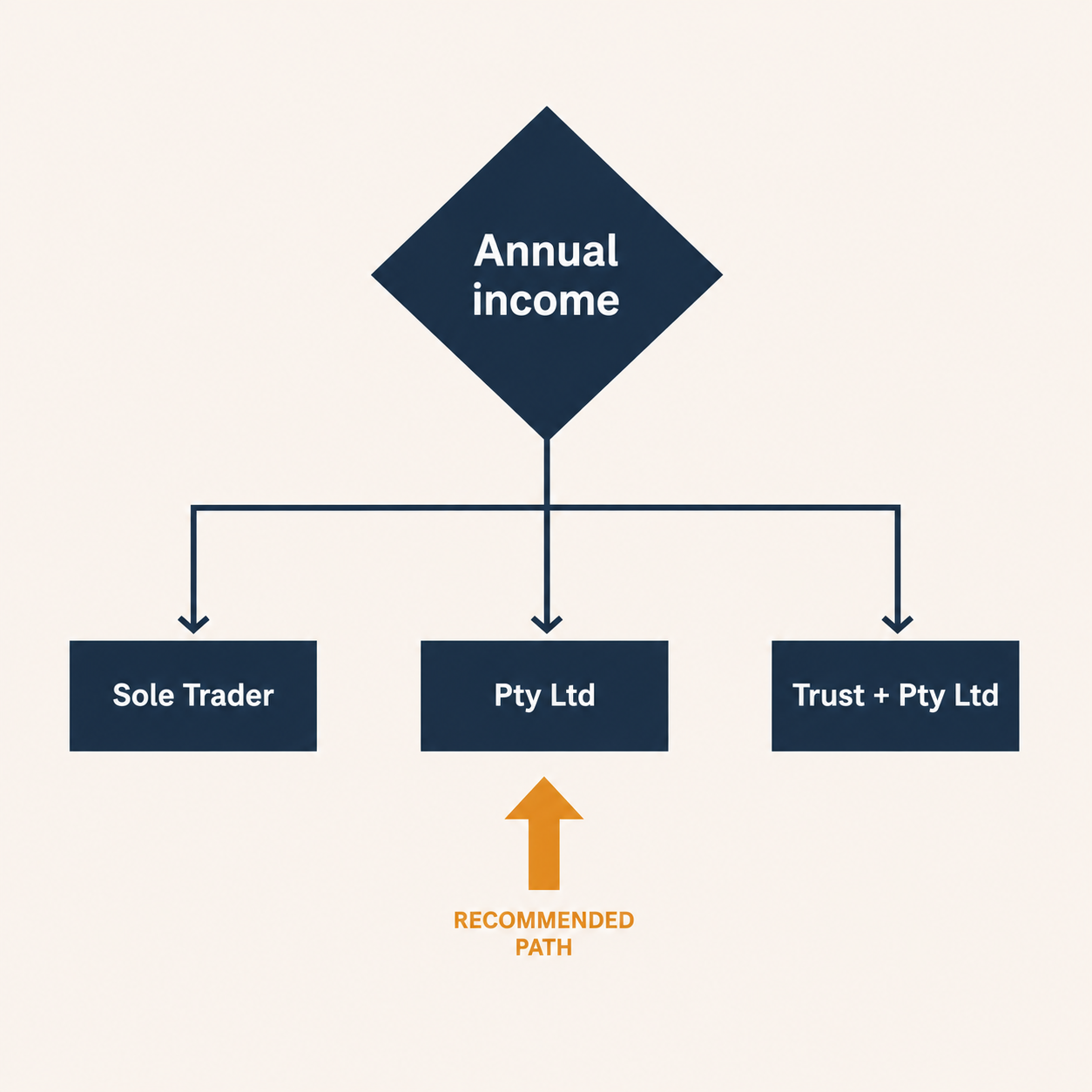
After all that, what should you actually do? Here’s the short version, by income level and situation:
If you’re earning under $80,000 in net business income, your business has no employees, and your work doesn’t carry meaningful liability beyond what insurance can cover: stay a sole trader. Don’t over-engineer.
If you’re earning $80,000-$135,000, your business has any of the following – employees, inventory, contracts, or a customer base that could plausibly sue: move to Pty Ltd. The liability protection is worth the compliance cost.
If you’re earning $135,000-$200,000 as the sole earner with no other family members in the picture, and your business is purely services: Pty Ltd is still usually the right call. The income-splitting benefit of a trust isn’t available to you (no one to split with), and the company structure gives you flexibility for retention and eventual sale.
If you’re earning $200,000+ with multiple family members able to legitimately share in the income, the business owns appreciating assets, and you can absorb the compliance cost: Pty Ltd as trustee of a discretionary trust is the standard play. Get a tax agent who specialises in trusts to set it up; getting trust deeds wrong is expensive and annoying to fix later.
If you’re a professional in a regulated field (law, medicine, accounting) where the regulator restricts available structures: your professional body and a tax agent in your specific field will know the rules. The general framework above doesn’t apply cleanly.
This is a framework, not advice. Your specific situation may differ. The point of this article is to be the thing you read before the meeting with the tax agent, not the thing you act on without one.
How to change structures later
Restructuring isn’t impossible, but it isn’t free either. The main considerations: Capital Gains Tax (CGT) – when you transfer assets from one structure to another, there’s often a CGT event. Specific small business CGT concessions and rollovers can reduce or eliminate this, but you need a tax agent to navigate them. Stamp duty varies by state and type of transfer. Disrupting customer relationships – invoices, contracts, bank accounts all need to be re-issued under the new entity’s name. Time – a clean restructure typically takes 3-6 months with proper planning.
The right time to restructure is usually one of three moments: when income crosses a threshold that changes the optimal structure (e.g., revenue moving from $100K to $400K), when you bring on a co-founder or investor, or when you’re entering a higher-risk phase (employees, big contracts, inventory). The wrong time: panic-restructuring at the end of a strong financial year because someone told you about tax savings without considering the wider implications.
Frequently asked questions
Do I have to register a Pty Ltd through ASIC, or can I use an online service?
You can do either. ASIC’s direct route costs less ($611 setup) but takes more form-filling. Services like Lawpath, Cleardocs, and Sleek charge $400 to $800 to do it for you with templates included. Either is fine for a standard structure; the more important investment is getting the trust deed (if any) drafted by an actual legal professional.
Can I switch from sole trader to Pty Ltd mid-year?
Yes. The new company starts trading from the date of incorporation. You’ll have two tax events in the same year – your sole-trader income up to the switch date, and the company’s income from then on. Plan it for 1 July if you can, to align with the tax year and reduce paperwork.
Is a Pty Ltd always cheaper to run than a sole trader?
No. A Pty Ltd has significantly higher compliance costs ($2,500 to $5,000/year vs $800 to $2,000 for sole trader). It only makes financial sense when the tax savings, liability protection, or growth optionality justify the additional cost.
Do I need a separate bank account for my business?
If you’re a Pty Ltd, yes – legally required because the company is a separate entity. If you’re a sole trader, technically not required, but strongly recommended for record-keeping and ATO audit trail.
Can a sole trader employ people?
Yes. You’ll need to register for PAYG withholding and super guarantee, and meet all employer obligations. Many tradies operate as sole traders with one or two employees for years before structurally moving to a Pty Ltd.
If I start as a sole trader and grow, when’s the right time to switch to a Pty Ltd?
Most accountants give roughly the same answer: when one of three things happens – your net business income reaches around $100,000 and you’re not drawing it all personally, you take on employees or significant inventory, or a customer signs a contract that would put your personal assets at meaningful risk. Whichever happens first.
Do trusts have to distribute all their income each year?
For a discretionary trust running an operating business, yes – practically. Any income retained inside the trust is taxed at the top marginal rate (47% in 2025-26). Trustees almost always distribute fully each year to avoid this.
Want this in your inbox each week?
Plain-English Australian tax. For SMEs, tradies, and founders. Free, forever.
Sources
This article references the following primary sources. All are publicly accessible:
- Australian Taxation Office (ATO) – individual income tax rates 2025-26: ato.gov.au
- ATO – base-rate entity company tax: ato.gov.au/businesses-and-organisations
- ATO – trust income distributions and Section 100A guidance: ato.gov.au
- Australian Securities and Investments Commission (ASIC) – Pty Ltd registration and fees: asic.gov.au/for-business/registering-a-company
- Treasury – Corporations Act 2001 directors’ duties (overview): treasury.gov.au
Disclaimer: This article is general educational information based on Australian tax law and corporate law as at May 2026. It is not a substitute for advice from a registered tax agent, BAS agent, or legal practitioner. The right business structure depends on your specific situation, income, family composition, asset base, and goals – none of which a general article can know. Before acting on any structure decision, book time with a qualified professional. The numbers used in worked examples are illustrative and use 2025-26 rates published by the ATO.